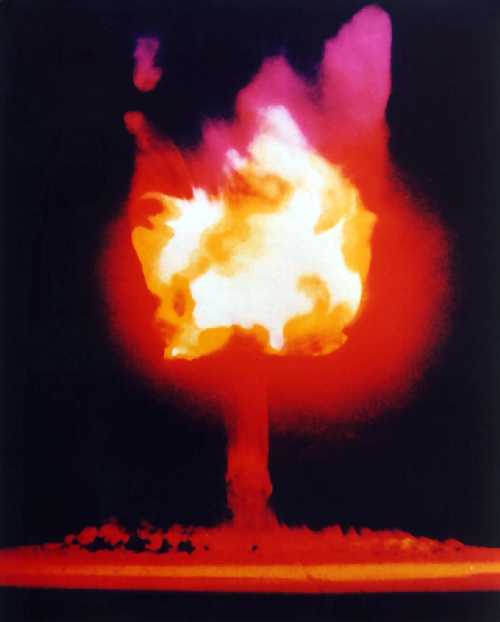
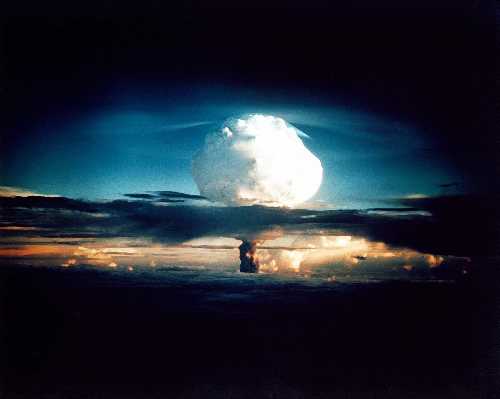
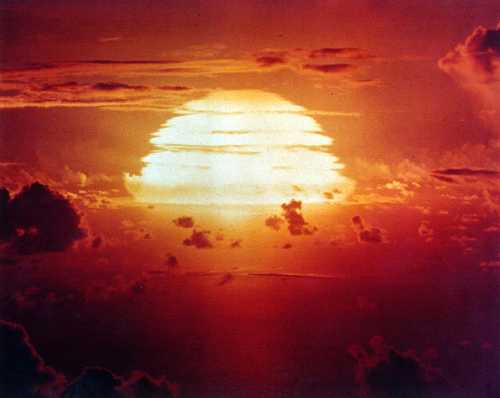
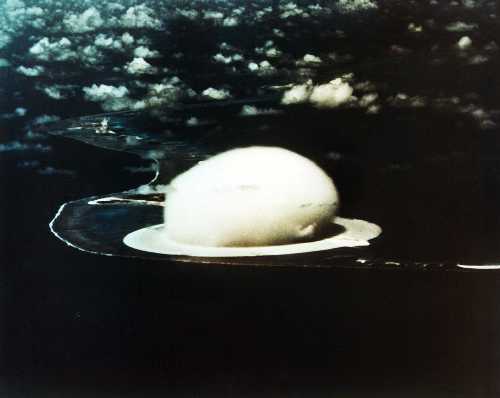
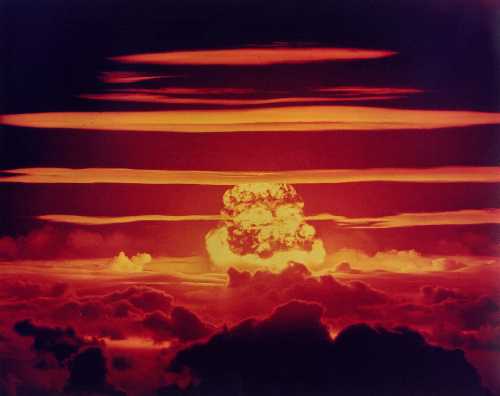
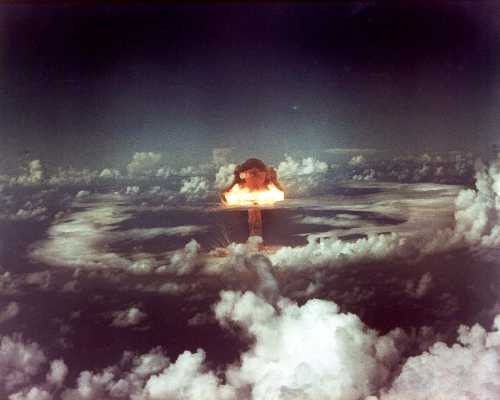
| Screenshots Of Nuclear Explosions! | ||
|
|
|
|
|
|
| Nuclear Weapons And How They Work...... |
| By now most of the world has heard of the atomic bomb.It is the harnessing of the basic power of the universe.But since this site is purely educational I will touch on the topics of nuclear fission and fusion. |
| Nuclear Fission, Hiroshima and Nagasaki |
| The two
atomic bombs, Little Boy and Fat Man, that were dropped
on the cities of Hiroshima and Nagasaki in August 1945,
were bombs of the fission type. Fission is generally the
splitting of an atom (uranium-235) to produce other
isotopes of other elements and energy. Little Boy was
uranium-235 based, with 2 uranium slugs fastened at
opposite ends of a hollow rod. One slug was firmly
affixed, and the other was loose with a priming charge of
TNT behind it. When the bomb was dropped, and at some
distance from the ground, the TNT will ignite, and shoot
the uranium slug at bullet speed towards the other one.
When they crushed, a critical mass was formed and stray
neutrons inside this mass will bombard the uranium atoms,
forming uranium-236. This isotope is unstable and breaks
down forming krypton-90 and barium-143 with 3 free
neutrons and energy. The 3 neutrons will go on to bombard
the rest and this chain reaction continues. The energy
released is so great that the bomb eventually explodes
brilliantly. Below is the general equation for this
reaction: 235U + 1N--->236U--->90Kr + 143Ba +3N +energy The bomb used on Nagasaki was plutonium-239 based, whose explosion equalled 23000 tons of TNT. Little Boy was 21500 tons.It's explosion is based on the same concept as Little Boy. |
| Nuclear Fusion and The Hydrogen Superbomb |
| In 1952 the
world's first hydrogen bomb was detonated at the island
of Eniwetok, vaporising it completely. So, just how do
hydrogen bombs work? How are they detonated? Hydrogen bombs are so powerful that they require atomic explosions to set it off. Firstly, atomic triggers (small quantities of uranium-235) are placed in a ring inside the casing. Secondly, two isotopes of hydrogen, deuterium and tritium are placed in a layer surrounding the atomic triggers. When the atomic triggers are detonated, the great heat and pressure formed causes the deuterium and tritium to fuse together, forming helium. This in turn causes a loss of mass as helium is lighter than deuterium and tritium. This loss of mass is then converted to a tremendous amount of heat and light energy and the bomb finally explodes. |
| Screenshots Of Nuclear Explosions! | ||
|
|
|
|
|
|